

Businesses strive to deliver on their objectives not only through talented employees but also through effective leadership. Performance management is the process that aligns managers and staff on the former’s expectations of the latter and how employees can meet them. It involves engaging staff through discussions about what has been achieved and what could be done to improve the situation. This article aims to explain what it is, give an idea of objectives, and discuss why it is essential for businesses in 2026.
What Is Performance Management?
It is an ongoing process that helps an organization maintain and improve employee performance Management while connecting individual work with business objectives. It includes setting expectations, establishing objectives, monitoring progress, giving feedback, supporting development, and evaluating results.
The main purpose is to clarify what employees need to achieve and how success is measured. CIPD describes this as a continuous cycle in which objectives and feedback can change as business priorities change. Performance is not measured in exactly the same way for every role. A sales position may use revenue or customer metrics, while a designer may have goals related to project delivery, quality, and collaboration. Measures therefore need to match each job.
How Does Performance Management Work?
It is usually a cycle that includes planning, monitoring, developing, and reviewing. Those stages are practical for most of the cases.
Set Goals and Objectives
Managers and employees establish the main outcomes; thus, the employee needs to know what they are supposed to do and how these tasks contribute to the team or organization. For some work, especially the work that has a clear end result, it should set quantitative goals. While for other types of work, personal, learning, and behavior goals may be relevant.
Establish Performance Measures
After the goals are set, managers should identify performance measures for the employee. The best practice is to use Key Performance Indicators. Herewith, KPI’s are used to measure a particular indicator that shows what progress is being made toward the achievement of the goals. Thus, the key result areas are the measures for individual goals.
Monitor the Performance and Provide Feedback
Managers and team leaders monitor the performance throughout the year and provide feedback. It is a critical step for most of the employees. In addition, the feedback should be precise and related to the actual work or results. Year-round reviews allow the worker to realize what they did right, what they did wrong, and what they need to do for improvement. Herewith, the feedback should be specific and evidence-based.
Review the Performance
The final stage of performance management is reviewing performance. Thus, this stage allows both the manager and employee to discuss the results, achievements, challenges, development areas, and future goals. Therefore, performance reviews are a continuous process, which is not limited to a formal annual appraisal. In addition, the goals and objectives may change based on the company’s needs and the employee’s responsibilities.
Key Components of Performance Management

Each of the key components plays a separate role, but they are combined into a single process that regulates this management. These components allow managers and employees to understand what is expected and what can be expected in return.
Goal Management
This component ensures that employees have a clear understanding of the goals to be achieved. They should reflect the scope of responsibilities since it is a guiding principle for the manager and employee in the work process. A goal may differ depending on the level of responsibility and nature of the work; therefore, the manager should consider these details when setting expectations. In addition, if the company’s priorities change, the goals should be reconsidered.
KPI Tracking
This part of performance management allows the manager to track the progress of an employee against the set KPIs to determine their contribution towards the goals. In turn, KPIs should be selected in accordance with the employee’s responsibilities and the desired result for the company. For example, sales managers will set different KPIs for their employees than customer service managers since they are engaged in different types of work.
Performance Measurement
This component sets the basis for analysis and discussion of performance results. Multiple factors can be used for measurement, including quantitative data, qualitative aspects, project results, and employee feedback. It should be noted that a single metric reflecting the employee’s work is not always a useful indicator.
Feedback and Coaching
During the work, the manager should give feedback to the employee on the results already achieved in order to identify any deviations and discuss them. Additionally, the manager may offer coaching services to help the employee learn new things. At the same time, the manager should listen closely to the employee to detect problems that require coordinated efforts to find a solution. In other words, the manager must differentiate between the skills issue and the work process issue.
Development and Recognition
The component shows how employees can develop within the company. The manager should analyze the results of the work and the problems that arise, and discuss possible improvements and training courses that can be taken. Moreover, in the context of recognition, the manager should note achievements and explain to the employee what exactly has yielded positive results.
Performance Management vs Performance Appraisal
An appraisal usually refers to a formal assessment of an employee’s work over a defined period, while the broader process includes goal setting, ongoing monitoring, feedback, development, and formal evaluation. SHRM and CIPD describe appraisals or reviews as one component within a wider approach.
| Aspect | Performance Management | Performance Appraisal |
| Scope | Covers the full performance cycle | Focuses on formal evaluation |
| Timing | Ongoing throughout the year | Usually occurs at set intervals |
| Communication | Includes manager-employee discussions | Centers on a formal review conversation |
| Purpose | Supports ongoing improvement | Documents and discusses performance results |
| Adjustment | Support can change as needs change | Primarily reviews work already completed |
The two processes work together. A formal appraisal is more useful when supported by clear goals, documented progress, and regular conversations.
Common Performance Management Mistakes to Avoid
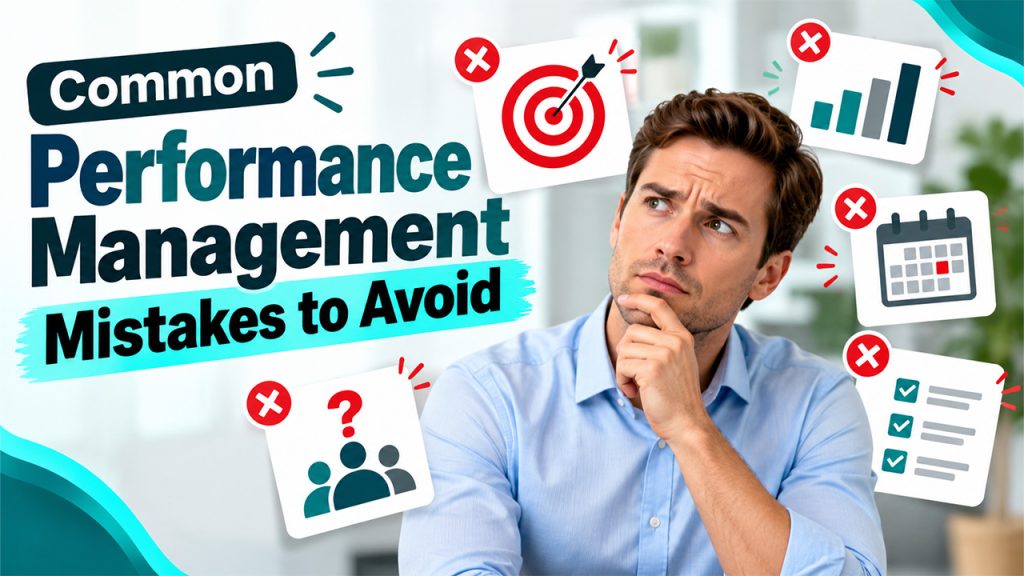
A structured performance management process can still create problems when businesses overlook role, context, and communication.
Setting Unclear Goals:
Vague goals make it difficult for employees to understand what success looks like. Managers should define outcomes, measures, and time frames.
Using Irrelevant Metrics:
A metric that does not reflect an employee’s responsibilities can create misleading conclusions. Measures should match the role and outcome.
Waiting for the Annual Review:
When managers discuss performance only once a year, employees may receive feedback long after an issue occurs. Regular conversations give employees opportunities to adjust.
Ignoring Context:
Performance data needs context. A missed target may result from skill gaps, unclear requirements, limited resources, changing priorities, or factors outside the employee’s control. Managers should discuss the circumstances before reaching conclusions.
Failing to Follow Up: A review should lead to clear next steps. Managers can document actions, development needs, revised goals, and follow-up dates.
Conclusion
This management process of an organization relies heavily on precise expectations, continuous communication, and measurable targets in place. Therefore, companies need to develop procedures that enable both growth for employees and fulfillment of organizational objectives. By integrating these aspects, performance management aids organizations in melding the objectives of their employees into the organizational goals and makes their progress possible.
It is more effective when supervisors consider it a continuous process rather than a year-end activity. By 2026, an effective system will allow mixing conversations with performance metrics to help employees recognize what is expected of them and overcome obstacles on their way to achieving organizational objectives.
Frequently Asked Questions
What is the main purpose of performance management?
The main purpose is to align employee work with business objectives while supporting improvement. It combines goals, measurement, feedback, development, and evaluation.
How often should performance be reviewed?
Performance should be discussed regularly rather than only during an annual review. Frequency depends on the role, goals, and type of work.
What is the difference between a KPI and a goal?
A goal describes an intended outcome, while a KPI is a measure used to track progress or performance against an important objective. A goal can have one or several relevant measures.
Is a performance appraisal the same as this process?
No. An appraisal is a formal evaluation within the broader process. The wider approach also includes goal setting, ongoing feedback, progress monitoring, development, and adjustments throughout the year.