

Payroll refers to one of the most regular and essential financial operations within a company. On the one hand, employees expect to receive their wages on time and in full. On the other hand, the business has to account for employee earnings, withholdings, taxes, benefits, and relevant records accurately and in a timely manner. Payroll management describes the systematic process required to ensure the satisfaction of both sides. It is possible to delegate the responsibility for payroll processes to a team, software, or external organization. The complexity of payroll depends on the company size, the number of employees, applicable tax regulations, and other factors.
What Is Payroll Management?
It can be defined as the management of employee compensation and ensuring that it is correct and paid on time. The payroll process comprises calculating an employee’s wages, recording hours worked, tracking overtime, managing benefits and deductions, and creating employee checks and payments. It also includes the maintenance of the payroll, which usually requires withholding taxes and reports to responsible agencies.
Payroll Management include various details like salaries and hourly wages and can consist of bonuses, commissions, reimbursements, and benefits for workers. In addition, a business considers employees’ leave, overtime, and approved deductions in the payroll process. It is designed in a way that ensures employees are appropriately compensated while the company can track the employee’s payment accurately.
How Does Payroll Management Work?
Payroll follows a series of steps that help businesses calculate employee pay accurately and complete payments on time. While the exact workflow varies by company, most payroll operations follow a similar sequence.
Gather Employee Data:
Obtain employee information, hours worked, pay rate, leave and vacation, taxes, overtime pay, bonus, and any other pay or benefits information. Accurate and updated data helps prevent errors during later payroll calculations.
Calculate Gross Pay:
For example, if you’re paying an employee a salary, then you need to determine their pay rate and how many hours they work each week. The calculation also considers overtime, bonuses, commissions, and other applicable earnings.
Check Payroll:
HR or payroll staff will review all of the payroll data and all calculations to check for errors or additional items. This review helps identify incorrect information before the payroll is approved.
Pay Employees:
Once approved, employees get their net pay through the company’s payroll method. The net pay reflects the employee’s earnings after applicable taxes and deductions.
Store Payroll:
Save payroll data and generate reports for employees, managers, accounting, and regulatory reporting. Keeping these records helps the business track previous payments and payroll information.
The way businesses handle these steps depends on their size, resources, and payroll requirements, which leads us to different types of payroll methods.
Types of Payroll Management
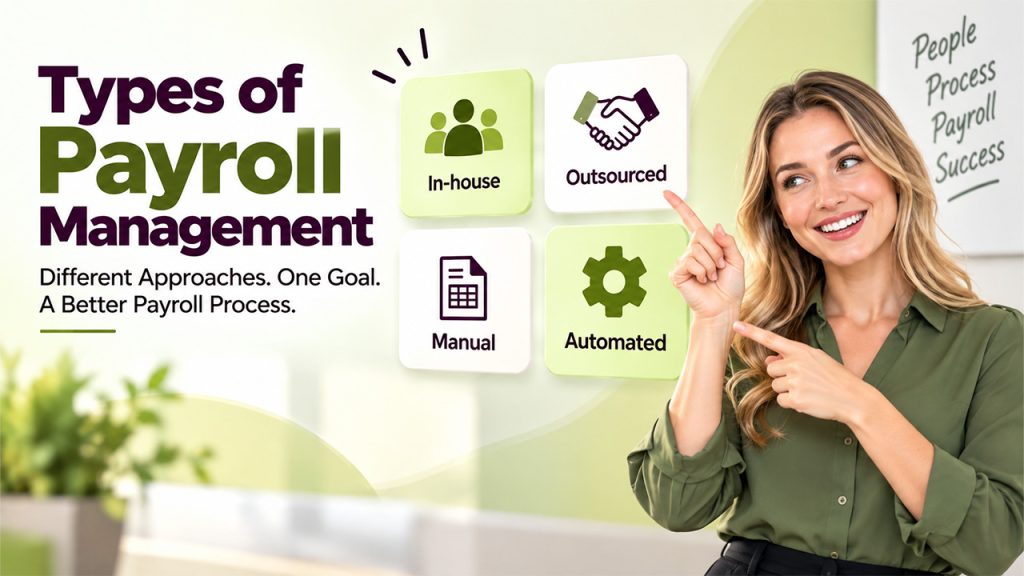
Businesses implement various methods and techniques to ensure proper management according to their specific needs, workforce, resources, and other factors. All methods can be generally divided into four types based on critical elements such as work nature, employee count, and tools used.
In-house Payroll Management:
When a company uses its employees in accomplishing payroll-related tasks. In other words, a firm’s HR, finance, accounting, and payroll departments carry out all activities related to processing and paying wages.
Outsourced Payroll Management:
When a company uses an external organization to perform specific payroll processes like taxes calculation and payments, report generation, and others. In other words, a firm pays another business to manage specific tasks.
Manual Payroll Management:
When a business uses tables, sheets, calculators, or basic accounting software to process wages. Usually, small businesses apply this type of management when the number of employees is not significant.
Automated Payroll Management:
When a business uses a special software solution that automates and integrates payroll processes. In other words, the program helps to calculate wages, time, taxes, and reports and syncs with other systems like tracking, HR, accounting, and self-service portals.
| Type | Best For | Main Focus |
| In-house | Larger Businesses | Internal Control |
| Outsourced | Growing Businesses | Expert Support |
| Manual | Small Businesses | Basic Processing |
| Automated | Scaling Businesses | Process Automation |
Key Features of a Payroll Management System
A payroll software or a payroll platform is a unified system that incorporates calculation, employee data, payments, reporting, and controls. The features offered range between vendors, but there are basic components that come along with a solid system.
Automated Pay Calculations:
Supports the payroll process by entering gross wages based on salary, hourly wages, hours worked, overtime, bonuses, commissions, and wages, and applies the appropriate deductions to generate net pay. Having automation to aid in the calculations can minimize repetitive calculations while providing consistency for each pay period.
Tax and Deduction Management:
Calculates and deducts taxes and other employee deductions based on the configured rules. Deductions can include contributions to employee benefits, retirement deductions, legal garnishments, and more. Rules and entries must be updated in the system to ensure accuracy.
Time, Attendance, and Leave Automation:
A payroll system can be linked to a time and attendance system that incorporates worked hours into the payroll calculation. Automation links the time taken from the attendance system with the actual hours worked, updating the payroll calculations.
Employee Self-service:
Employees can access their pay statements, view tax documents, examine their payroll history, and make some changes to their data without requesting every change from HR.
Security and Access Control:
The payrolls in the system contain sensitive data and should be protected accordingly. Security measures and information access can be restricted and secured through authentication or encryption, among other techniques.
Benefits of Payroll Management System
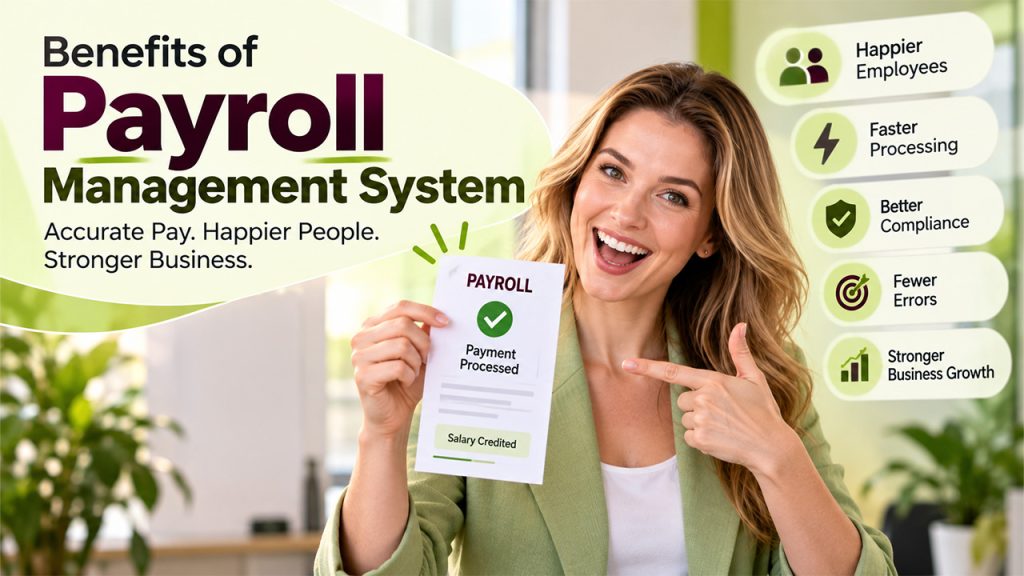
Payroll isn’t a function that exists to make the finance department’s job easier. It also helps employees, HR teams, managers, and business leadership make sure payment is accurate and easily available.
Accurate Payments for Employees
A good payroll system helps ensure paychecks get to employees when they should and are calculated correctly. You avoid payroll errors, and employees aren’t confused by incorrect calculations.
Faster Payroll Processing
Automation saves your HR and finance teams from a lot of review, entry, and duplicate entry. Your staff can work more on recruitment, engagement, business planning, and assisting the people who make your business function smoothly.
Better Assistance for Compliance
Payroll requires numerous reports, recordkeeping, taxes, and paycheck calculations that are all location and employee specific. A good system can help you organize and apply the rules you need to use, and aid with keeping up to date on changing regulations.
Fewer Payroll Errors
Taking lots of information from one place and entering it repeatedly invites mistakes. An integrated payroll system can import, export, and automate calculations to reduce this risk.
A Good Employee Experience
Employees often want pay stubs, old paychecks, and tax information on demand. System login, a salary portal, and online access to previous pay information all make pay processing easier for your staff.
Conclusion
Managing employee pay is a vital business function that involves calculations of wages, deductions, taxes, payments, record keeping, and reporting. HR professionals can manage payroll in-house or outsource it to specialist providers or automate it through payroll software. In an increasingly digital business environment, automating payroll can mean fewer repetitive calculations, better recordkeeping, enhanced compliance, more self-serve access to pay information for staff, and CRM-Payroll integration with other HR management tools.
For an enterprise to meet its objectives and adhere to all legal obligations, the choice of an in-house or outsourced payroll provider will depend on the number of employees, payroll complexity, in-house expertise, budget, and legal requirements. A professional and well-structured payroll process is particularly helpful as a business grows to ensure accurate payments and better control of payroll-related data for HR and finance teams.
Frequently Asked Questions
What is the main purpose of Payroll Management?
The main purpose is to ensure employees receive accurate and timely compensation while the business manages deductions, taxes, records, and reporting requirements correctly.
What are the common types of payroll?
The common types include weekly, biweekly, semimonthly, and monthly pay schedules. Businesses can also choose in-house, outsourced, manual, or automated approaches for handling payroll activities.
What is the difference between payroll management and payroll processing?
Payroll management covers the broader administration of employee compensation, records, compliance, and controls. Payroll processing focuses on calculating wages, deductions, taxes, net pay, and issuing employee payments.
When should a business use payroll software?
A business can consider payroll software when manual calculations take significant time, employee numbers increase, payroll becomes more complex, or the company needs stronger reporting, automation, and employee self-service.