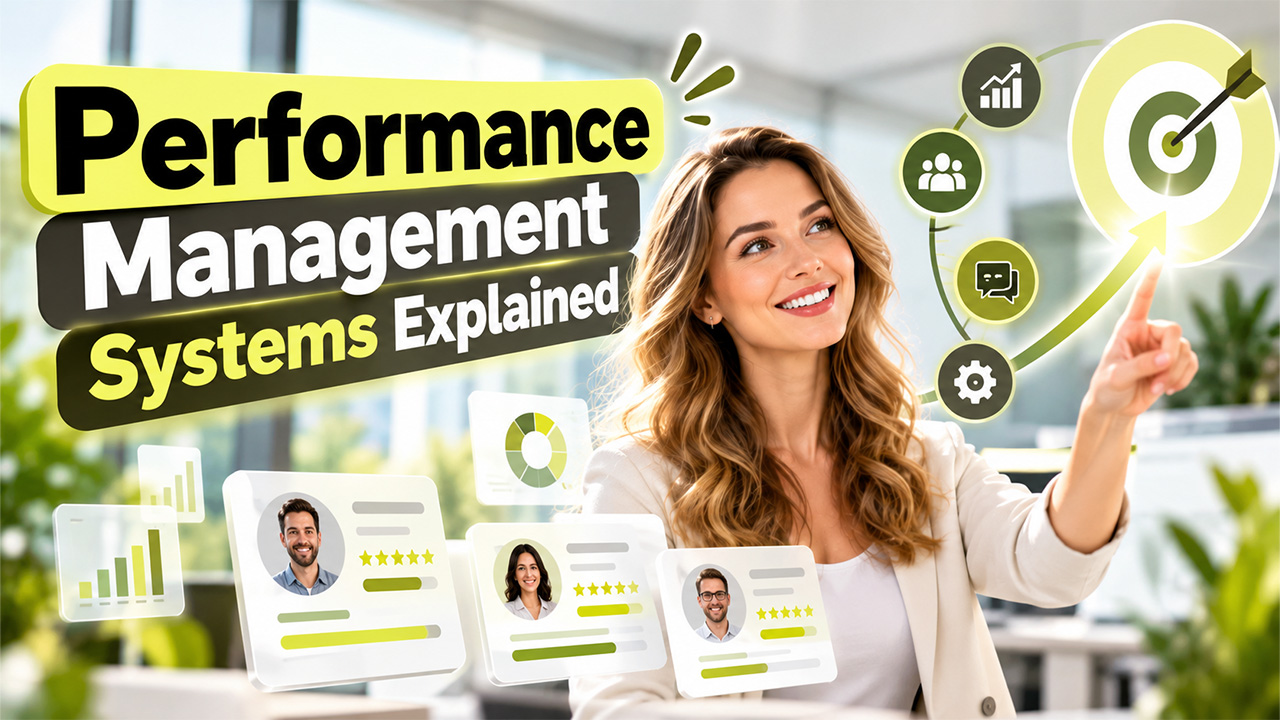

A performance management system refers to the set of processes, methodologies, and technology used by companies for setting goals, tracking progress, assessing performance, and developing the skills of employees in order to support the business objectives. It can also operate as part of a broader employee management system that centralizes employee records, attendance, and other HR processes.
It works effectively when the efforts of an individual are linked to organizational success and can be used as the basis for making decisions about pay, advancement, and succession. This article outlines what performance management systems are and discusses why they are needed along with describing types and examples of them.
What Is a Performance Management System?
Performance management system can be defined as a software that allows organizations to set goals, track progress, give feedback, and assess the performance of their employees in a consistent and measurable way.
It is also important to differentiate the above term from “performance management”. According to management professor Herman Aguinis, performance management can be viewed as a constant process that involves identification, measurement, and improvement of individual performance in accordance with business strategy.
As for the history of performance management system, it dates back to early models that emerged in the military sector during the two World Wars. In the middle of the twentieth century, business organizations started to use appraisals as means of assessing performance and awarding bonuses to those who perform well. Starting from the 1960s, more focus was made on development, and today it is characterized by the shift from annual reviews to continuous performance management and regular one-on-one conversations.
For managers and HR professionals, the system also works as a source of information about their employees. It gives justification for promoting, rewarding and succeeding someone, and helps to identify who needs development.
Why Performance Management Systems Matter
A performance management system is necessary as it translates effort of each individual into contributions that can be measured in line with organizational objectives. Without an organized system, the performance management process will fall back on managers and incomplete data leading to strategies that are not aligned to the company’s objectives. An effective system will eliminate such inconsistency and establish a predictable approach to set expectations, monitor and evaluate the results of effort.
Strategic alignment:
It is a connection between individual and organizational goals and the ability to update the goals depending on changing priorities of the organization.
Evidence-based decision-making:
Decisions about promotion, remuneration, relocation and successions are evidence-based and objective with performance information and thus help minimize any bias, build trust among employees and give an organization a legal cover in case there is a dispute about a decision.
Frequent and timely feedback:
According to a Gallup report, employees have 3.6 times greater motivation to achieve outstanding performance when their managers provide feedback on a daily basis compared to providing such feedback annually.
Employee development and retention:
Employees’ performance data helps an organization to discover skills gap and career ambitions and thus allocate development and learning efforts in the right direction. Recognition of top performers will minimize the risk of losing valuable talent.
Employee performance data helps organizations identify skills gaps, understand career ambitions, and direct learning efforts appropriately. Establishing clear expectations during the employee onboarding process can also help new hires understand their responsibilities and performance goals from the beginning.
These four features define a performance management system that connects individual efforts to organizational priorities, evidence-based workforce decisions, frequent feedback and talent development and retention.
Types of Performance Management Systems
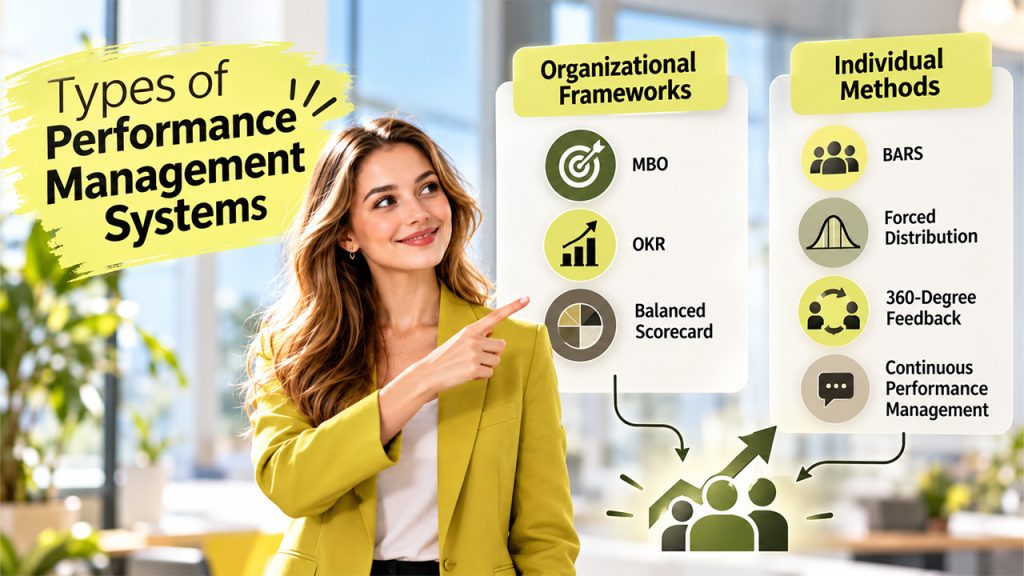
Performance management systems tend to be classified based on their scope. Organizational frameworks are a set of performance measures that reflect the strategy and cascading down to teams and individuals, whereas individual methods evaluate and develop the individual contribution of each worker. Below, there is a description of the main types of both organizational and individual systems.
Organizational Frameworks
Management by Objectives (MBO):
MBO was introduced by Peter Drucker in 1954. It implies joint definition of objectives by managers and employees as well as periodic review of the progress towards these objectives thus aligning individual objectives with organization ones.
Objectives and Key Results (OKR):
This system was developed by Andrew Grove in Intel in 1970s as an improvement of MBO. It consists of a qualitative objective and quantitative key results, which reflect whether or not the objective has been met.
Balanced Scorecard:
Balanced scorecard system was developed by Robert Kaplan and David Norton in 1992. The balanced scorecard includes performance measures of strategic management in four different perspectives: financial, customer, internal process, and learning and growth. Moreover, the financial results can be correlated to the operational drivers of such results.
Individual Methods
Behaviourally Anchored Rating Scales (BARS):
BARS were developed by Smith and Kendall in 1963. It implies that every level of rating is anchored to a certain behaviour, thus, making the rating system less subjective.
Forced Distribution (Bell Curve):
This method was pioneered by General Electric in the 1980s. It implies ranking of employees among each other in certain proportions, which are 20 percent top performers, 70 percent average performers, and 10 percent low performers. As forced distribution assumes the normal distribution of performance among every team, most companies stopped using this method. Modern business management software helps organizations coordinate operations and make informed management decisions.
360-Degree Feedback:
360-degree feedback system implies collection of information about a worker from different sources including manager, peers, direct subordinates, and worker’s own self-assessment. This method is primarily used for development purposes.
Continuous Performance Management:
This approach substitutes the infrequent formal review by continuous one-on-one meetings and feedback.
Most organizations use a goal-setting framework in conjunction with one or several appraisal and feedback methods depending on strategic needs, workforce structure, and developmental or reward-oriented purpose of the system.
Performance Management Software and Tools
Performance management software simplifies the processes of setting goals, giving feedback to employees, conducting performance evaluations, calibrations, and analysing data. Typically, performance management tools are divided into two main types:
Human Capital Management (HCM) Suite:
Examples of HCM suite include Oracle, SAP, UKG, and Workday that combine performance management with the processes of compensation, training and development, and succession planning, good for companies with complex HR processes.
Performance Management Systems:
Performance management platforms like Lattice and Leapsome focus on tracking goals, feedback, performance evaluations, and manager coaching.
Examples of Performance Management Systems
There are various approaches to using performance management systems in organizations, and there are multiple known examples demonstrating how a good performance management systems operate.
Google: Objectives and Key Results:
Google uses the OKR methodology developed by Andrew Grove in 1970s. An objective is combined with key results, which are rated from 0.0 to 1.0 at the end of the period.
Adobe: Check-In:
In 2012, Adobe stopped using annual ranking of employees and switched to more regular check-ins. This new method of managing people is based on goals and expectations set for each quarter, continuous feedback, and employee development.
Performance Snapshots:
Deloitte found that filling out forms, holding meetings, and giving ratings wastes up to 2 million hours per year. The company changed its performance management system by focusing on four questions, which were to be answered by team leaders.
Balanced Scorecard:
The first balanced scorecard appeared in Analog Devices in the 1980s before Kaplan and Norton published their article in the Harvard Business Review in 1992. The framework organizes objectives and measures across four perspectives: financial, customers, internal business process, and learning.
Microsoft and General Electric:
Forced Ranking. Microsoft refused to use stack ranking in 2013. It implied that managers had to rate employees according to predetermined shares of employees receiving, satisfactory, and poor ratings. General Electric ranked employees and fired those who occupied one of the lowest percentiles. Later, the company launched PD@GE application for feedback.
Conclusion
The performance management system lays down the foundation through which an organization can match up employee performance to its objective goals, provide proof for organizational decisions and maintain continuous feedback. The performance management processes at companies such as Google, Adobe, Deloitte, Microsoft and General Electric show that the process is fluid and can be changed based on priorities and goals.
Frequently Asked Questions
What is the main purpose of performance management system?
The main purpose of a performance management system is to ensure that performance of employees meets organizational objectives and provide ways to improve the same.
What problems a performance management software solves?
Performance management software solves problems such as lack of clear objectives, inconsistent feedback, manual reviews, and tracking employee performance.
How often should performance be reviewed?
Performance should be monitored continuously, with formal reviews conducted quarterly, biannually, or annually, depending on organizational needs.
What is the difference between performance management and performance appraisal?
Performance management is an ongoing process of setting goals, monitoring progress, and improving performance, while performance appraisal is a formal evaluation of employee performance at a specific point in time.
What are the most common challenges in implementing performance management systems?
Common challenges include low employee adoption, inconsistent manager participation, goals that are not revisited, and infrequent feedback. Selecting a system that is easy to use and embedded in daily workflows addresses most of these.