

Getting a new hire’s paperwork signed is easy. A real employee onboarding process is built to help them feel ready, confident, and part of the team by week two. Too many companies still treat onboarding as a single first-day event instead of the ongoing process it actually needs to be.
Well done; it influences how long people stay and how soon they become productive. Done badly, it is usually the unspoken reason why good recruits leave after only a few months.
In this blog, we’ll walk through what the process actually involves, why it matters, and the concrete steps that make it work.
What Is the Employee Onboarding Process?
Employee onboarding is the process of integrating a new hire into a company, covering everything from paperwork and tool access to understanding team culture and actual job expectations. However, it does not happen within one day because the employee needs some time to transition from “being technically hired” to being a part of the team.
This differs from simple orientation, which usually covers the basics: filling out forms, a facility tour, and an ID badge. Onboarding goes deeper. It’s about making sure someone understands not just where the bathroom is, but how their role fits into the bigger picture, and what success actually looks like in their first few months.
Why It Matters
The onboarding process is one of the main factors determining how long an employee stays. The scientific literature proves the fact that the retention rate for new hires goes up by much if the company offers a proper onboarding process rather than leaving them on their own from the very beginning.
Productivity is another thing to take into consideration. An onboarding process allows people to get used to all the necessary things, like tools, other employees, and expectations. That speed matters more than most companies give it credit for; a slow ramp-up quietly costs money every single week.
In addition, there is a cultural part of the issue. The first weeks of employment create the first impressions that people usually hold forever.
Employee Onboarding Process Steps
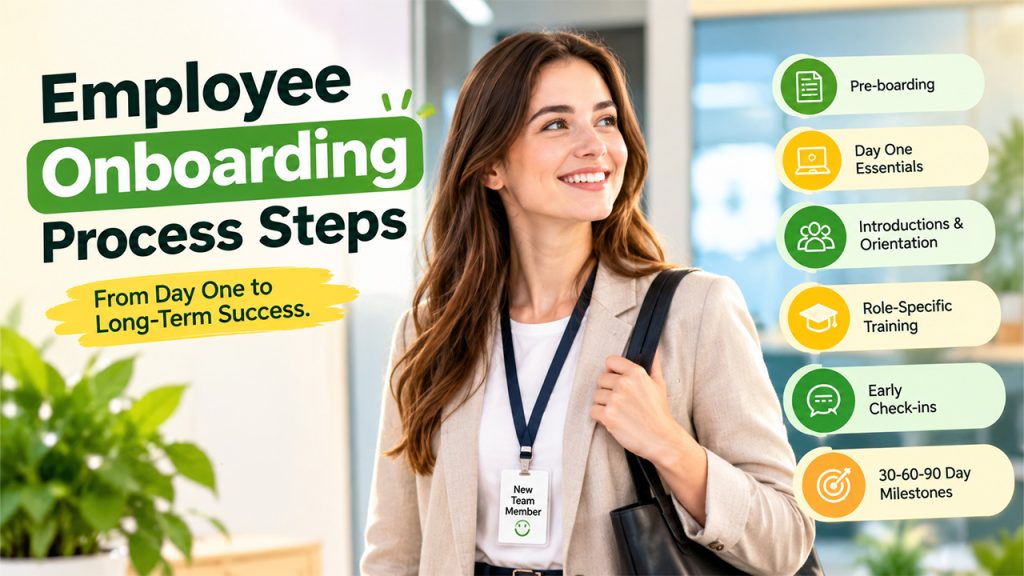
There is a general structure of an efficient onboarding process that remains the same despite slight differences in activities from one firm to another:
Pre-boarding: Send confirmations, contracts, and any other paperwork in advance so that the new employee does not spend time on them on day one.
Day one essentials: Make sure that all the accounts, necessary hardware, and access to the system are set up in advance to avoid the situation when a new employee sits idle due to the absence of any necessary equipment or access.
Introductions and orientation: Talk about corporate culture, policies, and introduce the new employee to their team.
Role-specific training: It will provide more detailed information regarding tools and processes associated with the particular role.
Early check-ins: Regular short meetings within the first several weeks for identifying possible difficulties in adaptation.
30-60-90 day milestones: Set clear goals for the first month, the first quarter, and check progress against them at each stage.
Most companies handling this at scale rely on some form of HRMS to keep these steps organized and consistent across every new hire, rather than relying on scattered spreadsheets or memory.
Employee Onboarding Checklist
Having a simple employee onboarding checklist on hand keeps nothing from slipping through the cracks, even during a busy hiring month:
- Offer letter and contract signed
- IT accounts, email, and system access set up
- Hardware and workstation ready before day one.
- Welcome message or team introduction sent
- Company policies and handbook shared.
- Role-specific training scheduled.
- First-week check-in booked.
- 30-60-90 day goals documented
- Assigned buddy or mentor for the first few weeks.
Keeping this consistent across every hire is a lot easier with a proper employee management system in place, since it turns a checklist that lives in someone’s head into something trackable and repeatable for the whole HR team.
Common Mistakes to Avoid
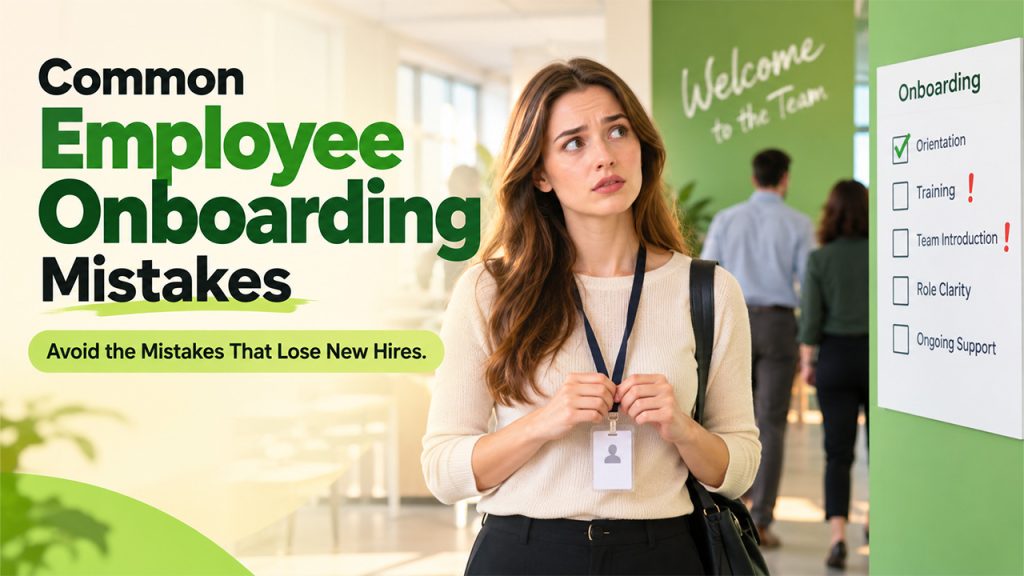
Well-meaning efforts at onboarding can end up being less effective than they might have been simply because these pitfalls are overlooked:
Treating it as a one-day event:
Good onboarding takes time, and rushing it means leaving loose ends that will come back to bite you.
Information overload on day one:
Trying to load a new employee with all of the rules and resources in one day is going to be overwhelming.
No follow-up after week one:
Without regular follow-ups, those minor problems that crop up can fester into something serious and unfixable.
Missing role clarity:
The inability to know what success looks like in a role will make onboarding difficult.
Inconsistent process across hires:
Without any sort of repeatable process, the quality of onboarding depends on whoever’s in charge at the time.
Avoiding these doesn’t take a complete overhaul, just a bit more structure and consistency that most companies default to.
Conclusion
Employee onboarding is not something difficult; it just requires some effort and thought. Preparing ahead of time, spacing training sessions, and keeping communication channels open are some of the simple steps that ensure a smooth entry into your company for any new hire.
If done correctly, your efforts will pay off in the form of employees who are able to get into gear quickly and integrate into your team much faster. If done incorrectly, even the best hires might become detached from the job without ever fully settling in.
Employee onboarding is one of those processes that need only be set up correctly once because all subsequent hires will benefit from it.
Frequently Asked Questions
How long should the employee onboarding process take?
Most effective onboarding stretches across the first 90 days, not just the first week. That timeline gives new hires enough space to build confidence, understand their role fully, and settle into the team without feeling rushed through everything at once.
What’s the difference between orientation and onboarding?
Orientation takes care of all the basics, like paperwork and facility tours within one day. In contrast, onboarding takes much more time to get employees oriented to their job and the working environment as a whole.
Who should be involved in onboarding a new hire?
Though the HR department is often in charge of logistics for onboarding, the manager and team of the new hire are equally important. It will help establish real connections and perspectives that cannot be established by HR alone.
What happens if onboarding is rushed or skipped?
The new hires will feel like they are being left alone or are confused regarding their roles and responsibilities, which will definitely result in lower productivity and eventually higher employee turnover within the initial months after joining.
Can onboarding be different for remote employees?
Absolutely, remote onboarding typically requires more deliberate check-ins and well-defined documentation because there is no opportunity to approach a colleague in the office and ask a question.