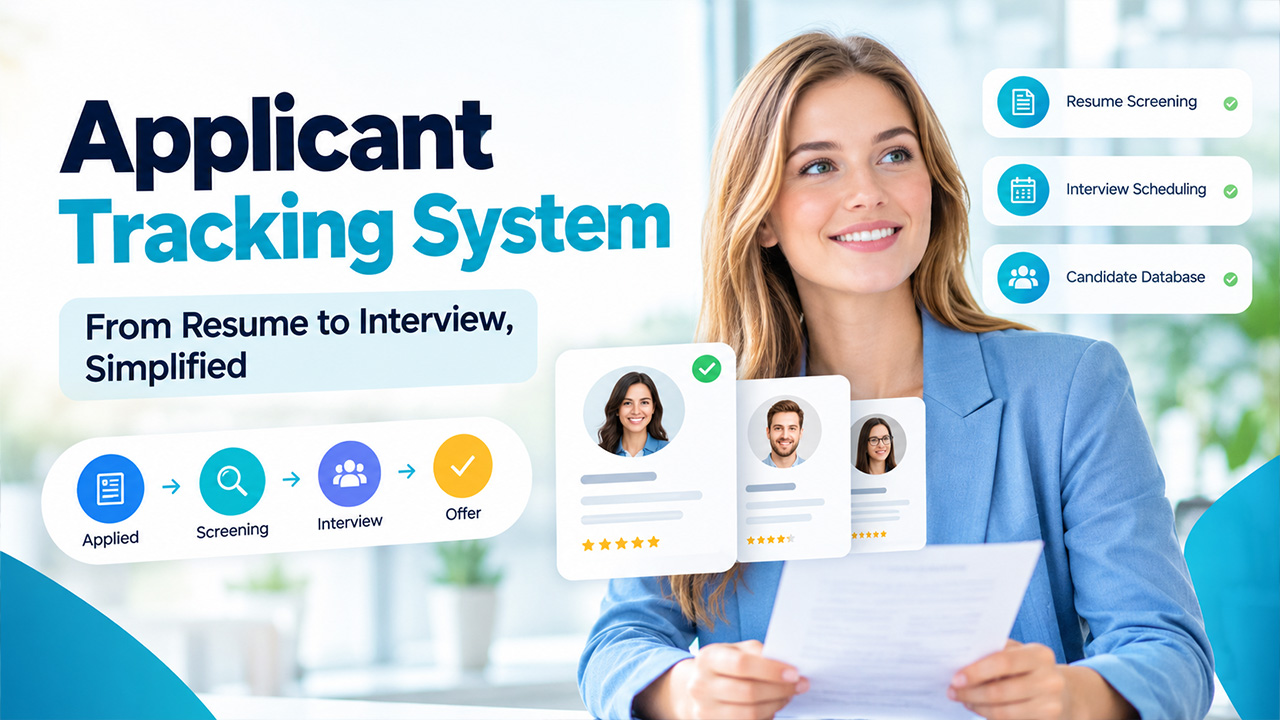

Recruitment consists of several stages, such as publishing job openings, screening resumes, coordinating interviews, assessing candidates’ suitability and onboarding. Handling this work manually becomes difficult as the number of applications grows.
It causes time wastage, creates administrative hurdles, and complicates the entire hiring process. That’s where an Applicant Tracking System comes into play. An ATS simplifies the entire recruitment journey by organising candidate details, screening applications, tracking hiring progress, and coordinating among recruitment team members.
Moreover, such systems automate repetitive administrative tasks that consume significant hours of recruiter’s & hiring manager’s time. In this guide, you’ll learn what ATS is, why it matters, and how it works.
What Is an Applicant Tracking System?
ATS is a software that assists organizations in the hiring process. It collects data about candidates, job applications, resumes, and organize them into one platform. The technology allows recruiters to arrange candidates with high efficiency and keep the hiring process uniform.
An ATS supports many parts of the hiring process – those include posting a job vacancies, filtering out resumes, arranging interview times, storing information, and offer letters, etc. Many platforms offer functions to extract data from resumes, tools to send messages to candidates, reports on hiring data, as well as connections to job websites or HR software.
By removing the use of separate spreadsheets, long email threads and manual documentation in favour of an organised system, an ATS makes the entire flow of hiring candidates easier. Recruiters and managers can view data about candidates, work together on hiring tasks and track recruitment with more a lot more accuracy – but the features of an ATS depend on the company that makes the software. Some platforms have tools that perform tasks automatically and create detailed reports, while other platforms only provide basic ways to manage applicants.
How Does an Applicant Tracking System Work?
The way an ATS works depends on your business needs and its features.
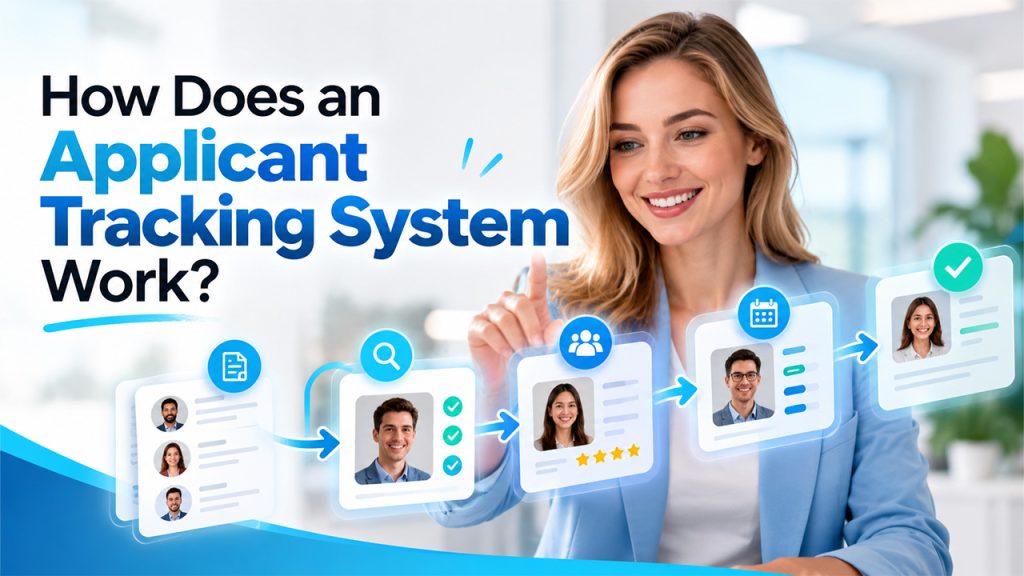
But generally speaking, these systems manage all the data about job candidates as well as different stages of recruitment via a certain workflow. And here are some common stages that most ATS solutions cover:
Job Posting and Application Collection
Once recruiters have created their jobs with the necessary details like responsibilities and qualifications, they can use their ATS’s ability to post those job descriptions on different job boards and career pages. When people apply via those job postings, that data will be automatically entered into your company’s centralized database of candidates.
Resume Parsing and Candidate Screening
ATS uses resume parsing technology when candidates submit applications by extracting all relevant information from their resumes – including their contact details, work experiences, education, skills, etc.
Then the ATS puts this information together in order to create searchable candidate profiles for recruiters to look through.
Finally, recruiters or an automated system will analyse each application based on how well it fits with pre-defined criteria relating to that specific job position. This process sometimes involves using keyword matching and/or other types of algorithms to match the similarity between the job and the resume.
Candidate Tracking and Communication
During a candidate’s progression and your hiring process, recruiters will update their status at each stage – for example, “application received”, then “screening”, followed by “interview”, “assessment” and finally “offer”.
These are all tracked by your ATS and allow you to easily see who requires follow-up from the team.
Interview Scheduling and Team Collaboration
ATS tools also help coordinate interviews – they allow you to schedule interviews together, take notes of an interviewer’s feedback on a candidate, and keep track of important candidate details all in one location. This lets hiring managers and others on your team review and comment on each applicant’s application as well.
Who Uses an Applicant Tracking System?
Applicant tracking systems are utilized by professionals and organizations involved in the hiring process – ranging from small businesses to larger-scale enterprises.
HR Manager:
They are responsible for overseeing various activities related to the recruiting process, keeping track of applicants’ details, monitoring the hiring progression, ensuring all processes adhere to the organizational policies, etc.
Recruiters & Talent Acquisition Specialists:
They publish jobs, view application status, review and shortlist resumes, communicate with candidates about interview schedules, candidate pipelines management, etc.
Hiring Managers:
They give feedback on interviews, assess whether each applicant meets specific job criteria, and coordinate hiring decisions between HR and recruitment teams.
Recruitment Agencies:
They often have very large candidate databases they need to manage, as well as keep track of which candidates meet different clients’ needs for roles at different times. They rely heavily on an ATS to do that effectively.
Small and Medium-sized Businesses: They typically don’t have access to huge amounts of dedicated recruitment resources but still want a way to organize their application processes, eliminate lots of manual admin tasks, and streamline their hiring process.
By centralizing the candidate info & hiring activities, you’re giving all of these people better ways to coordinate efforts & keep track of things.
Why Is an ATS important in Hiring?

The importance of an Applicant Tracking System cannot be emphasized enough. An ATS system is a great way to ensure that your company can manage recruitment more easily – especially if you get lots of applications or are hiring for different roles at once. This tool will help keep things running smoothly for your recruitment team by organizing all relevant information about each candidate throughout their hiring journey.
Benefits of an ATS Include:
Reduce manual work
This software can automate tasks like gathering resumes, organizing them properly within your database, setting up interviews with interviewers, employee onboarding, etc., freeing up recruiter’s time.
Improve candidate screening
The app assists recruiters in identifying applicants matching specific criteria like educational background/qualifications, skills required & experiences expected from potential employees.
Strengthens team collaboration
Recruiters & hiring managers are able to view the candidate profile, share interviews, and keep track of progress within a centralized system. It helps reduce communication gaps between the parties.
Improves Recruitment Visibility
An ATS keeps track of all the candidates at various stages of hiring, which allows you to pinpoint where there might be delays.
Supports Consistent Hiring Process
With standardized workflows on board, recruitment teams will ensure that they follow the same steps across vacancies.
Overall, an ATS can help your organization reduce administrative efforts while improving coordination during hiring processes to ensure more informed decisions are made when recruiting talent.
How to Choose an Applicant Tracking System?
Selecting the right Applicant Tracking System (ATS) requires checking the organization’s needs, hiring volume, and learning curve of the tool and pricing. The below-listed elements are important to consider while choosing an ideal Applicant Tracking System:
Identify Recruitment Requirements
Evaluate essential features; consider whether the system will enable you to manage large numbers of applications easily, see, if it has functionality to screen resumes and coordinate interviews automatically and also look into whether the ATS allows for tracking several vacancies at once.
Check Integration Capabilities
Ensure your ATS integrates well with existing HR software, job boards, calendar apps, and other recruitment tools. This will reduce redundant data input and improve information sharing between systems.
Assess Ease of Use
Select an ATS platform with a user-friendly interface so recruiters and hiring managers can easily learn how to navigate it.
Review Security & Compliance
Check what security protocols are available when it comes to protecting sensitive candidate information.
Consider Cost and Scalability
It is crucial to assess the overall cost of the tool, whether its subscription-based or usage-based. And, finally, before coming up with an ultimate decision on which service you want to go for, always consider requesting a demo of their service. It gives you the chance to test out their application based on how you would be running your recruitment process.
Conclusion
An ATS helps organizations manage recruitment more efficiently by centralizing candidate information, automating routine tasks, improving coordination between recruiters and hiring managers. From collecting applications to tracking candidates and evaluating hiring performance, an ATS supports a more structured recruitment process.
Frequently Asked Questions
What does ATS stand for?
ATS stands for Applicant Tracking System, which refers to software that manages your recruitment process.
How does an applicant tracking system work?
ATS collects your applications, sorts & scans them for resumes, keeps track of candidates and helps recruiters throughout the hiring process.
Can an ATS automatically reject resumes?
Yes, but only if they’re configured to do so.
Is an ATS suitable for small businesses?
An ATS can help small businesses to keep their applications organized while minimizing manual processes and managing their recruitment process better.
Does an ATS replace recruiters?
No, although the applicant tracking system can support some of your recruitment tasks (e.g., evaluating candidates, conducting interviews), you are still expected to handle all aspects of the hiring process, for e.g., making final hiring decisions.