

A termination letter serves as official confirmation of the ending of a relationship between two parties. This could be employment, a lease, or even a contract. A poorly written termination letter might create problems down the line such as confusion on both sides, payment issues, or even a legal battle.
On the other hand, a good one has all the necessary information and it’s short and talks about the facts.
We will show you exactly how to write a termination letter with this step-by-step guide. We have included details on whether you need a letter, things to consider before writing one, and differences for different types (like lease).
What Is a Termination Letter, and When Is One Needed?
Mostly “termination” means ending a job. But sometimes it may refer to other things too—like if you’re leasing a space or signing a service contract. A letter of termination might be sent by employers, landlords or clients to formally close out their respective agreements with you.
While the term can mean many different things depending on its context, for instance, both “termination letter” and “letter of termination” are used interchangeably throughout various statutes, legal documents and company policies.
When Is a Letter Necessary? In instances where specific legislation requires a particular format, such as giving employees at least 30 days’ worth of written notice before they’re laid off, an employer would need to draft a termination letter (or another suitable form) explaining why there is no longer a place for you on their team. Likewise, if your employment contract calls for certain protocols to be followed in order to legally terminate your position — say through the involvement of your union reps — then having this sort of communication on paper makes sense.
Some states require companies doing business within their jurisdiction to notify prospective hires about certain conditions related to health insurance coverage, etc. A termination letter creates a dated record and limits later arguments about what was said.
What to Confirm Before Drafting the Letter of Termination
Start with your governing document – this will usually state the role’s lease or contract and have a termination clause. Ensure to detail all of the steps required here.
Check their notice period. This is simply how much time must pass before the end comes into force. It could also provide a ‘cure period’ during which they can address any problems. And find out how they need to receive the notice (Mail? Email? Hand?), too.
Ensure you have consistency between the draft letter and any previous documentation. The letter should reflect any previous warnings, reviews, emails or notes. This will cause issues if you’re not consistent. This letter should be issued after a direct conversation with the other party. It shouldn’t be used instead of having a conversation. No one should be finding out about the termination through a letter. If the role is being terminated for reasons outside of the employees’ control, extra caution should be taken, and the draft letter should be looked at by a lawyer or HR team.
How to Write a Termination Letter, Step by Step

A clear termination letter has five parts, and each has a job to do.
Step 1: Establish the Parties, Date, and Reference
Begin by stating the date that the letter was written, to avoid any arguments over when notice was given. Include the full legal names of the sender and recipient. Include what you are terminating – this could be a job title, property address, or agreement and reference number. A brief subject line explaining why you are writing will help the reader. This way anyone who reads the letter later should see who sent it, who received it, and what it covers. Maintaining accurate agreement details through a Contract Tracking System can also help businesses keep track of important contract information and deadlines.
Step 2: State the Decision and Effective Date
Open the first paragraph with the decision and state it clearly. For example, “… employment will end on [date]…”. Do not make your reader work out what you are trying to tell them. Be clear and concise. Make sure that the effective date takes into account any notice period. If the notice starts on receipt of the letter, then add the number of days it will take to deliver the letter. If you get the date wrong, the whole letter can be challenged.
Step 3: Provide a Concise, Factual Basis
Give one or two short factual reasons. It should be accurate and reflected in the documentation. Often a reference to the relevant contract clause is enough. Avoid personality and personal motives, stick to what actually happened and when. Long reasons will increase the risk of legal challenge by providing more information to argue against. Giving your opinion, strong words or unsubstantiated claims will give the other party cause for complaints. If there is no documentation to back up what you are saying then don’t say it.
Step 4: Set Out Next Steps and Duties
You should now outline what will happen next as part of the employee offboarding process. This should include any final payment and any payment for unused leave. Many places have strict timeframes which you should check. You should also include the date on which health and other benefits will stop. If there are any severance terms, you should include these. You should also ask them to return any company property such as keys, badges and laptops. You should also include one contact and their phone number/email address. If there is too much information to include in the letter, you should explain how and when they will get the rest of the information.
Step 5: Close, Sign, and Deliver with Proof
Conclude with a brief closing statement. Sign off with your name and title. Provide a place for the recipient to sign to acknowledge that they have received the letter. Send according to the requirements in the contract or law. If there are no requirements then posting the letter by hand with a signed receipt or using registered post is an effective option. Keep a copy of the letter and evidence of posting.
Termination Letter Sample

Below is an example of how all 5 steps can fit on one page. This example relates to employment, you will need to adjust it to suit your local legislation and company policy. Replace the information in the brackets with information relevant to your situation.
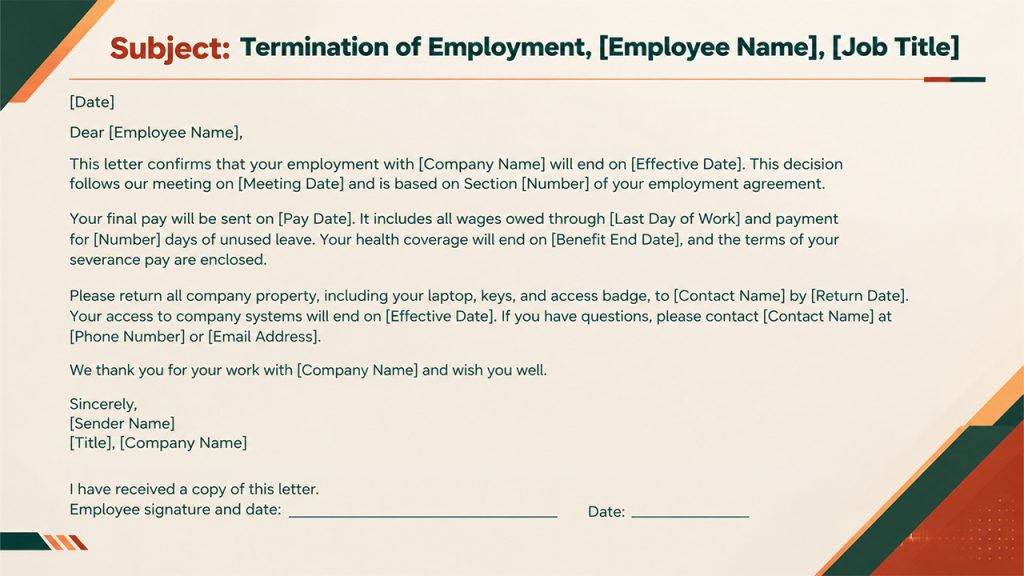
Have a lawyer review this sample before you use it in any real case. Laws and contracts differ by place, and one wrong phrase can lead to a costly dispute.
How a Lease Termination Letter Differs
The lease termination letter is also written using plain language. Check your lease document as there may be specific steps you need to follow. If you have a fixed term lease this will end automatically on the agreed date, so a letter matters mostly for month-to-month tenancies and early endings.
The most important piece of information in the lease letter is the notice period. This is usually 30 days for monthly agreements but will be outlined in your lease document and local law. The notice period can start from the date that the other party receives the letter. Ensure you send the letter in plenty of time so that you have extra days for it to arrive. Understanding the process of digital leasing can also help landlords and tenants manage lease agreements and related documentation more efficiently.
Conclusion
The above-mentioned tips are all you need if you want to write an effective termination letter. We have discussed four key elements which one should know while writing a termination letter.
Verify the Governing Terms – You must verify all the governing terms such as the notice period and how they are supposed to be sent to someone.
Write in Plain Words – Try to write everything in plain words without mixing up anything complicated.
Send With Proof – Make sure to deliver the termination letter along with certain proofs. Also, make a copy of your files for future purposes.
Keep All Statements Factual – If you want to avoid any dispute then make sure to use factual statements backed by some sort of records or documents
Frequently Asked Questions
What is a termination letter?
It is a written notice that formally ends an employment or contract.
Is a letter of termination the same thing?
Yes, "letter of termination" and "termination letter" are the same thing.
What should a termination letter include?
Include the date, parties, decision, effective date, brief factual reason, next steps, and a signature line.
How does a lease termination letter differ?
It mostly focuses on the notice period, mostly 30 days for month-to-month leases.
How should I deliver a termination letter?
Follow your contract's delivery method or use hand delivery with a signed receipt or registered post, and keep a copy.