
Managing employees involves much more than hiring people and processing salaries. Businesses must maintain employee information, track attendance, manage job roles, organize company policies, monitor employment changes, and ensure that important HR documents remain accurate. When these activities are handled through spreadsheets, emails, and disconnected applications, HR teams often struggle with duplicated information, administrative delays, and inconsistent records.
A core HR system provides a centralized solution for managing essential human resource activities. It brings important employee information and administrative processes together in one organized platform, allowing HR professionals to work more efficiently and make informed workforce decisions.
As organizations grow, maintaining accurate employee information becomes increasingly important. A reliable core HR system helps businesses simplify everyday HR operations, improve data accessibility, and establish consistent processes across departments.
In this guide, we will explore what a core HR system is, its essential features, major benefits, and how businesses can choose the right solution.
What Is a Core HR System?
A core HR system is a centralized software solution designed to manage the fundamental administrative functions of human resources. It stores employee information, maintains employment histories, tracks organizational changes, and supports routine HR activities throughout the employee lifecycle.
Instead of maintaining separate spreadsheets for employee details, job information, and employment documents, businesses can use one platform to organize these records.
For example, when a company hires a new employee, the HR team can create an employee profile containing personal information, contact details, department, designation, joining date, reporting manager, and employment status.
As the employee’s responsibilities change, the HR team can update the same profile without creating multiple records.
A core HR system also provides a structured foundation for other HR activities, including recruitment, onboarding, payroll coordination, performance management, and employee development.
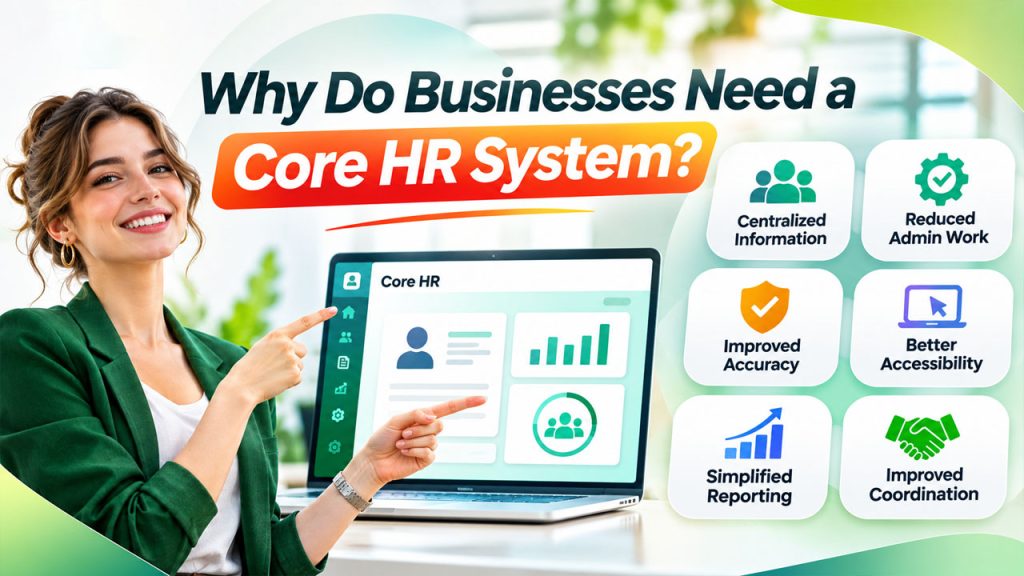
Why Do Businesses Need a Core HR System?
Managing employee information manually might work for a small organization with only a few employees. However, as the workforce expands, administrative responsibilities become more complicated.
HR professionals may need to update employee information across multiple spreadsheets, respond to repeated information requests, locate documents, and verify records before preparing reports. Implementing workflow automation solutions can help reduce repetitive administrative tasks, streamline information handling, and improve reporting efficiency.
These repetitive activities consume valuable time that could otherwise be spent on employee engagement and workforce planning.
A core HR system addresses these challenges by bringing essential information into one accessible environment.
Here are some important reasons businesses should consider implementing one:
Centralized information
Employee details remain organized in a single location.
Reduced administrative work
HR professionals spend less time managing repetitive documentation.
Improved accuracy
Consistent information reduces the possibility of duplicate or outdated records.
Better accessibility
Authorized employees can access relevant information when required.
Simplified reporting
HR teams can generate reports using organized workforce information.
Improved coordination
Different departments can work with consistent employee information.
With the right HR infrastructure, businesses can establish more organized and scalable workforce management practices.
Essential Features of a Core HR System
Not every HR platform offers the same capabilities. However, an effective core HR system should include several essential features that support daily administrative requirements.
1. Centralized Employee Information
Employee information is the foundation of effective human resource management. Businesses need a reliable way to organize personal details, contact information, employment history, department assignments, and job responsibilities. A centralized employee database helps businesses keep these records organized, accurate, and easily accessible.
An organized HR employee database makes it easier to find employee information without searching through multiple documents or email conversations.
HR professionals can maintain individual employee profiles and update relevant information whenever changes occur.
For example, if an employee moves from the marketing department to the sales department, the HR team can update the employee’s department and reporting structure within the same profile.
This improves information consistency and reduces unnecessary administrative work.
2. Employee Records and Document Management
Businesses handle different types of employee documents, including offer letters, employment agreements, identification documents, certificates, policy acknowledgments, and performance-related records.
Managing these documents manually can create difficulties, particularly when HR teams need to locate specific information quickly.
A core HR system supports organized HR records management by keeping employee documents associated with their respective profiles.
Depending on the platform, businesses can also use document categories, access permissions, and automated notifications to maintain better control over employee information.
These capabilities help HR departments improve documentation practices and reduce the risk of misplaced records.
3. Employee Information Updates
Employee information changes throughout the employment lifecycle. Employees may update their contact details, banking information, emergency contacts, addresses, or professional qualifications.
A centralized platform makes it easier to manage these changes systematically.
Some solutions also provide employee self-service functionality, allowing employees to submit updates directly for HR approval.
This reduces unnecessary communication and allows HR professionals to focus on more important responsibilities.
4. Organizational Structure Management
Understanding reporting relationships is essential for managing a growing workforce.
An effective core HR system helps businesses organize departments, job positions, reporting managers, and employee hierarchies.
HR teams can use this information to understand workforce distribution and identify organizational changes.
For instance, when a business opens a new department, administrators can create the department, assign employees, and establish reporting relationships within the system. An organizational chart management system can help businesses visualize departments, team structures, and reporting hierarchies as the organization grows.
5. Attendance and Leave Information
Employee attendance and leave management are important parts of everyday HR administration.
Many HR platforms provide tools for recording attendance, tracking leave balances, reviewing requests, and maintaining absence histories.
Employees can submit leave requests, while managers can review and approve them through defined workflows.
These capabilities help businesses maintain consistent attendance information and coordinate workforce availability.
6. Reporting and Analytics
HR teams regularly need information about workforce size, employee turnover, departmental distribution, joining trends, and employment status.
A centralized system makes it easier to organize this information and generate useful reports.
Businesses can use these insights to identify workforce patterns, monitor organizational changes, and support better management decisions.
Benefits of Implementing a Core HR System
Implementing a core HR system can improve how businesses organize employee information and manage administrative responsibilities.
1. Better HR Productivity
Manual HR administration often involves repetitive activities such as updating spreadsheets, searching for documents, and verifying employee details.
Automation and centralized information reduce these activities.
As a result, HR professionals can spend more time on recruitment planning, employee engagement, and workforce development.
2. Improved Data Accuracy
Maintaining employee information across multiple platforms increases the possibility of inconsistencies.
For example, an employee’s updated designation might appear in one spreadsheet but remain outdated in another.
A centralized solution reduces this problem by establishing a consistent source of employee information.
3. Stronger Information Security
Employee records contain confidential information that should only be accessible to authorized individuals.
Modern HR platforms can offer role-based permissions, authentication controls, activity logs, and other security features.
These capabilities help businesses establish controlled access to sensitive information.
However, organizations must also follow applicable privacy regulations, maintain appropriate retention policies, and regularly review access permissions.
4. Easier Business Scalability
As companies hire more employees, their HR administration requirements increase.
A scalable core HR system allows businesses to manage growing employee populations without depending entirely on additional spreadsheets or manual documentation.
Organizations can establish standardized processes that support expansion across multiple departments or locations.
5. More Consistent Employee Experiences
Employees benefit when important HR information and administrative services are easy to access.
Self-service portals, organized employee profiles, and transparent leave workflows can make routine interactions simpler.
This also reduces the need for employees to repeatedly contact HR for basic information.
Core HR System vs. HR Management Software: Understanding the Difference
The terms core HR system and HR management software are often used interchangeably, but they do not always describe exactly the same functionality.
A core HR system primarily focuses on essential employee administration, including employee information, employment records, organizational structures, and workforce documentation.
HR management software is a broader category that may include additional capabilities such as recruitment, payroll, performance management, learning management, employee engagement, and workforce analytics.
For example, a small business might initially need a centralized employee database and document management capabilities. A larger organization may require an integrated platform that also supports recruitment, performance reviews, payroll coordination, and employee development. Businesses can explore scalable HR management software to manage these functions through a unified platform.
The right choice depends on organizational size, existing processes, operational complexity, and future requirements.
How to Choose the Right Core HR System
Selecting an HR platform requires understanding both current administrative challenges and long-term business objectives.
Consider these factors before making a decision:
1. Identify your HR requirements
Determine which processes need improvement, such as employee information management, attendance, documentation, or reporting.
2. Evaluate essential features
Choose a platform that supports your most important administrative activities without unnecessary complexity.
3. Check integration capabilities
Ensure that the solution can connect with existing payroll, accounting, recruitment, and business applications where required.
4. Review security controls
Examine user permissions, authentication options, encryption, audit logs, and data protection practices.
5. Consider scalability
Select software that can accommodate additional employees, departments, and business locations as your organization expands.
6. Evaluate usability
A user-friendly interface helps HR professionals, managers, and employees adopt the platform more easily.
7. Understand pricing
Compare subscription costs, implementation expenses, training requirements, and additional feature charges.
Taking these factors into account can help businesses choose a solution that delivers long-term operational value.
Common Challenges When Implementing a Core HR System
Although HR technology offers several advantages, implementation requires proper planning.
One common challenge is inaccurate existing employee information. Before migrating records, businesses should review outdated entries, identify duplicate profiles, and correct missing information. Following a structured CRM data migration process can help businesses clean existing records and maintain data accuracy during system transitions.
Another challenge is employee adoption. HR teams and employees may need training to understand new workflows and system functionality.
Integration can also become complicated when organizations use multiple applications that store overlapping employee information.
To avoid these issues, businesses should establish clear implementation responsibilities, clean existing records, test important workflows, and provide appropriate training.
A phased implementation approach can also make the transition easier by allowing HR teams to introduce important features gradually.
Conclusion
A core HR system is an important foundation for businesses that want to organize employee information, simplify HR administration, and improve workforce management.
From centralized employee profiles and document organization to reporting, attendance tracking, and organizational structure management, the right platform helps HR professionals handle essential responsibilities more efficiently.
As businesses grow, relying entirely on manual processes becomes increasingly difficult. Implementing a suitable solution helps establish consistent administrative practices, improve information accuracy, and support long-term scalability.
Ultimately, investing in a core HR system is not just about replacing spreadsheets. It is about creating a more organized, accessible, and efficient approach to managing an organization’s most valuable resource: its people.
Frequently Asked Questions
What is the main purpose of a core HR system?
The main purpose is to centralize essential employee information and simplify HR administration. It helps businesses manage employee profiles, employment records, organizational structures, and other routine workforce activities.
What information is stored in a core HR system?
It typically stores employee contact details, job titles, department assignments, joining dates, employment history, reporting relationships, attendance information, and relevant employment documents.
Is a core HR system suitable for small businesses?
Yes. Small businesses can use it to organize employee information, reduce manual administration, and establish consistent HR processes as their workforce grows.
How does a core HR system improve employee data management?
It provides a centralized platform for storing and updating employee information. This reduces duplicate records, improves information consistency, and allows authorized users to access relevant details more easily.
What is the difference between a core HR system and a complete HR management platform?
A core HR system focuses on essential employee administration and recordkeeping. A complete HR management platform may include additional features such as recruitment, payroll, performance management, learning, and employee engagement.